

August 12, 2026
A timing belt replacement is among the most cost-effective services that your vehicle will ever need. But it plays an important role in maintaining the overall functionality of cars. If this belt loses tension, your car’s overall performance will be disrupted and you may hear a distinct clicking or ticking sound from the bonnet.
To prevent such occurrences, we’ll discuss what a timing belt is, its role in vehicles and the benefits of timely replacing this component. You’ll also learn how to spot the early signs of wear and when to book a timing belt replacement Perth.
What Is A Timing Belt?
A timing belt is a reinforced rubber belt installed on a car’s internal combustion engine to connect the crankshaft and the camshaft. Some vehicles also use a timing chain instead of a belt, which is a metal component that performs the same function with longer durability. Knowing which one your car uses is a basic part of good auto care services, and a technician can confirm it in minutes.
What Does It Do In A Car?
The timing belt’s function in cars is to maintain precise synchronisation between valve operation and piston movement. This belt ensures that the combustion occurs at the correct point in each cycle. In particular, this belt performs the following functions:
1. Building A Connection Between the Crankshaft To the Camshaft
The crankshaft converts the motion of the engine pistons into a rotating force. At the same time, the camshaft governs the opening and closing of valves. This belt ensures that these two components stay synchronised throughout every cycle.
2. Sustaining Engine Performance
Accurate timing is crucial for clean combustion, a stable idle, efficient fuel consumption and full power output from the car’s engine. If the belt is not changed when it deteriorates, the timing accuracy declines. Because of that, your car’s performance gets affected.
Also Read: What Causes Engine Failure And How Mechanics Fix It?
3. Governing the Valve Timing
The timing belt opens and closes the intake and exhaust valves at the precise point in each piston stroke. Through this process, it regulates when the air-fuel mixture enters the cylinder and when exhaust gases are expelled.
How Often Should You Replace Your Car’s Timing Belt?
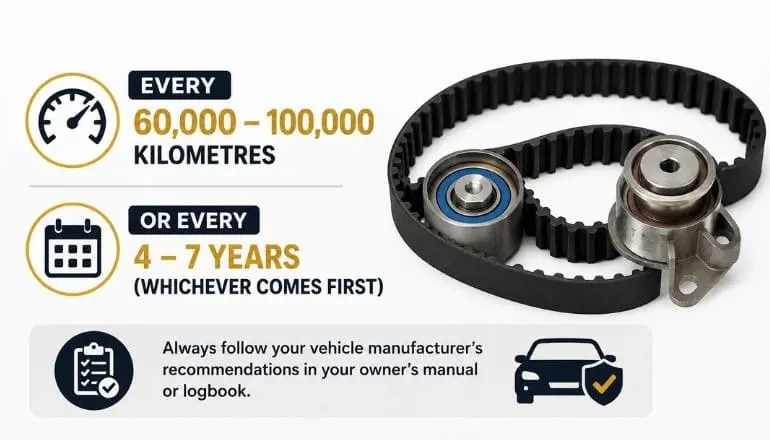
Most of the automobile manufacturers specify that you should replace your car’s timing belt between the intervals of 60,000 to 100,000 kilometres of travel or 4 to 7 years of car usage. The precise figures can vary by make and model. This is why you should look more closely at your vehicle’s logbook or owner’s manual to know the exact period for changing the timing belt. Keeping to that interval is the core of good engine timing belt maintenance and the easiest way to prevent an unexpected failure.
Signs Your Timing Belt Needs Replacement
A worn timing belt usually shows a few warning signs that you should not miss. Spotting these faulty timing belt symptoms early lets you act before the problem gets worse:
● A ticking or clicking sound from the engine
● Difficulty starting the car
● A rough or uneven idle
● Oil is leaking near the timing cover
● The engine warning lightcomes on
Benefits of Regular Timing Belt Replacement
Replacing your car’s timing belt on the recommended schedule is the simplest way to avoid expensive engine repair services. Below are five specific reasons to check your car’s timing belt and change it before they cause any functional issues:
1. Prevents Serious Engine Damage
Most of the petrol and diesel-run cars have an interference engine. In these engines, a broken belt alters the engine’s mechanical system, which may bend the valves, crack a piston or damage the cylinder head. It is one of the more expensive tasks to land on an auto repair shop’s bench, and changing the belt on time avoids it altogether.
2. Costs Far Less Than Engine Repair
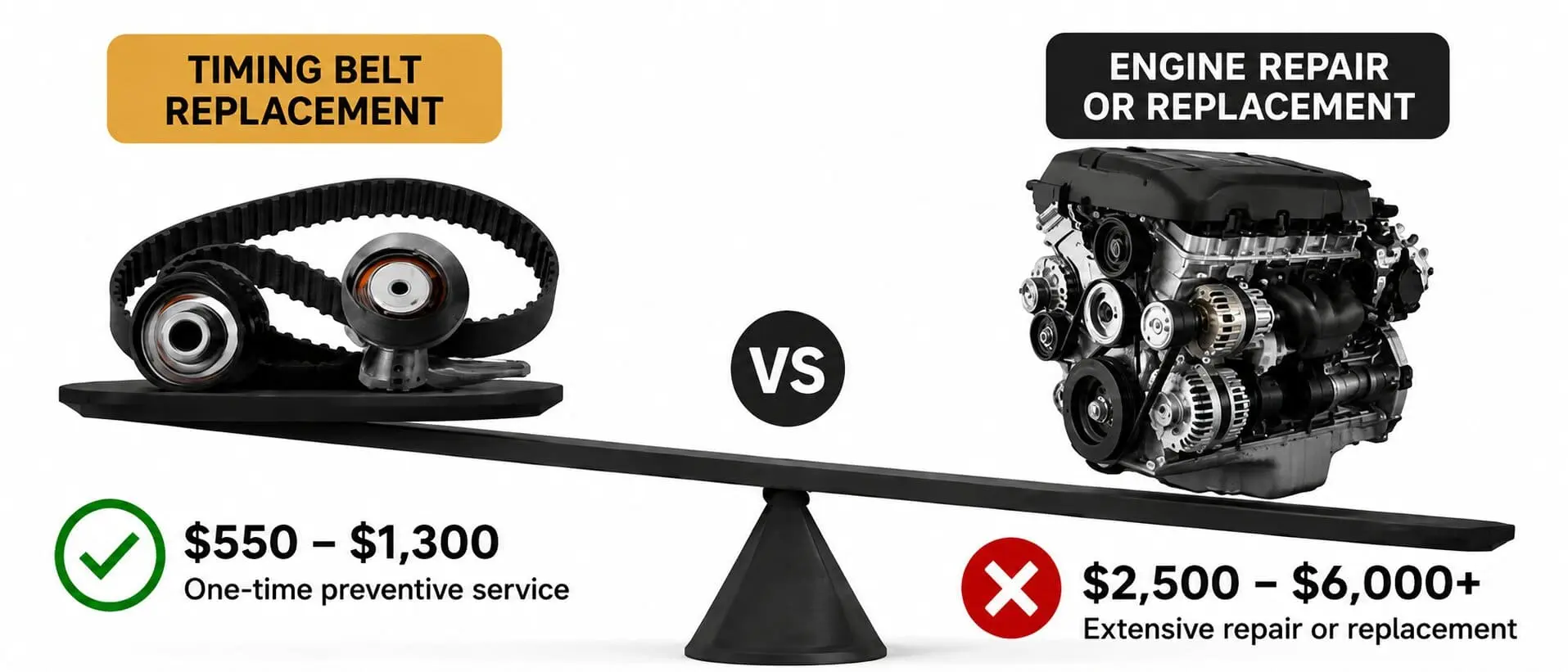
Most professionals’ timing belt replacement cost in Perth usually stays between $550 and $1,300. Whereas repairing or replacing your car’s engine can cost thousands of dollars. Some vehicle engines may cost more because of their complex mechanisms.
3. Keeps Fuel Use and Performance in Check
As your car’s timing belt gets older, it loses its strength. Because of that, the timing slips and fuel no longer burns at the right moment. As a result, you may experience weaker acceleration. A regular check at an auto care shop Perth catches such issues early, and a fresh belt restores full power and fuel efficiency.
4. Reduces the Chance of Being Stranded
When the timing belt breaks, the engine stops straight away. Replacing it on time lowers the chance of a roadside breakdown, the auto towing service and lost hours that come with it.
5. Makes Servicing More Predictable
A scheduled car servicing at your nearest car service shop helps you estimate a close budget for the total cost of replacing the timing belt. At the shop, mechanics also check other engine parts that may affect the overall performance of your car.
How Does Professional Timing Belt Replacement Help?
Installing a new timing belt by experts assures that the belt is fitted in the correct order and the timing is set to the right specification. Here is what with the best timing belt replacement service can help you fix this issue:
● The mechanic lines up the crankshaft and camshaft in the correct order and sets the belt to the right tension.
● Experts at the auto shop Perth also check nearby components such as the tensioner, idler pulleys, and water pump. If any of them are damaged, they will change these components after your approval.
● With the timing area opened up, the mechanic can check your car for oil leaks, coolant leaks, or worn seals to prevent any further damage.
● With professional installation, you can be assured that the belt and kit are matched to your exact engine.
Final Thoughts
Your car is part of your daily routine, whether it’s the morning commute, dropping the kids at school or heading off for a weekend away. A timing belt that fails mid-drive can disrupt all of these activities without any alerts. This is why replacing them on time through Perth’s best Auto Repair Shop prevents costly repairs as well as identifies any other concerns related to the engine’s performance.
FAQ’s
1. What happens if the timing belt is not replaced on time?
Answer 1:
If you do not replace the timing belt on time, it may slip or snap while driving. This can stop the engine immediately and cause serious internal damage that usually calls for professional engine repair services to put right.
2. Can a bad timing belt damage the engine?
Answer 2:
Yes, a failed belt can damage the internal components of the engine. In particular, it can bend valves, crack pistons, and damage the cylinder head.
3. What are the warning signs of a worn timing belt?
Answer 3:
The warning signs of a worn timing belt are a ticking or clicking sound from the engine, difficulty starting, oil leaks near the timing cover and the engine warning light turns on.
4. Can a timing belt fail without warning?
Answer 4:
Yes, a timing belt can fail completely without any warning. Because the belt is usually placed under a protective cover, you usually cannot track its degradation unless a mechanic performs a physical inspection.
5. How do mechanics inspect a vehicle’s timing belt?
Answer 5:
A mechanic removes the timing cover to check the belt for cracks, wear and correct tension. An engine diagnostics Perth workshop can also scan for related fault codes that point to a timing problem.
6. Can delaying timing belt replacement increase repair costs?
Answer 6:
Yes. A belt replacement usually costs a few hundred dollars at auto mechanic shops. On the other hand, repairing engines can cost thousands of dollars.